Photo:
Thailand Sea Nomads
STORY
Out With The Tide:
The Ebb Of Moken Culture
Written by
Sophie Coxon
The Moken tribe; sea-faring, indigenous nomads
Aquamarine, turquoise, teal. Sparks of sunlight splash across the flat plane of the sea like charged glitter, hot and fierce. The electric ring of insects fills the air, occasionally punctuated by the sharp calls of myna birds that can be heard but not seen, hidden in a junglish tangle of palm green that fringes the shorelines. Tiny metallic fish dance and leap in and out of the water with the flick of silver tails, delicate scales glinting in the bright light. Long stretches of bleached sand give way to a milky, humid haze hanging above the ocean, which seems to simmer in the heat. A stormcloud rolls across the distant horizon, an indigo bruise blurring the line between sea and sky.
As the static silence is broken by a cavernous gnarl of thunder, a spear pierces the water, seamlessly pinning a parrotfish to the seabed. The fisherman emerges, dripping, from the water, throwing his catch onto the bamboo slats of his Kabang. He is part of the Moken people, or Chaolay, an indigenous tribe native to the Andaman sea and western coasts of Thailand and Myanmar, living a predominantly nomadic, sea-faring lifestyle on hand-crafted bamboo houseboats.
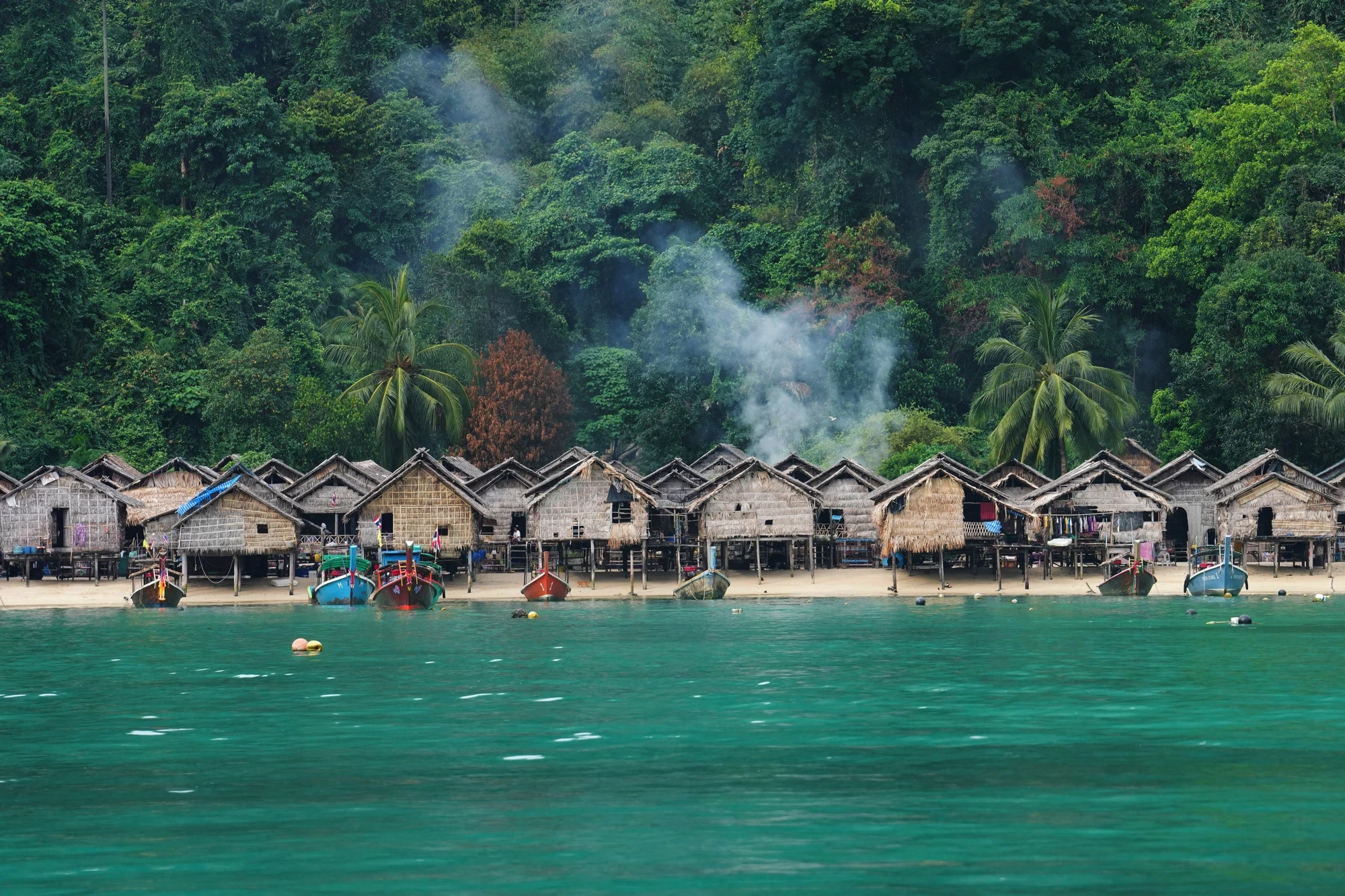
Approximately 3000 Moken live within the verdant stretch of tropical islands along the Thailand-Myanmar coastline, surviving on seafood caught on the reefs and a rich variety of plants gathered from the islands. The Moken have traversed the warm shallows and wild islands of the Andaman sea for centuries, originating from agriculturist groups in Southern China around 5000 years ago. Solely dependent on the raw riches of nature for survival, the tribe has refined and finessed the arts of spearfishing, fish trapping, and freediving for the shellfish embellishing the reefs. For the majority of the year, while the seas are flat and favourable, Kabang houseboats of bamboo, palm thatch and twine twisted from coconut husk are the centre of daily life, from cooking to sleeping. During the monsoons, families come ashore, building temporary villages on the boundaries where island jungles meet sun-scorched beaches, living in bamboo huts raised on crooked stilts above the burning sand. Afternoon downpours offer a cooling relief from the heat, washing the dust from the faces of children and running in sheets from banana-leaf roofs.
A biophilic alignment with nature
The traditional ways of the Moken tribe flex and meld with natural cycles, in a harmonious coexistence which embodies the ideals of ‘green living’ and sustainability that many western cultures strive, and fail, to emulate. Living at the mercy of nature, separated from the force of the sea and the sky by only a thin raft of bamboo slats and a canopy of palm leaves, the Moken are as closely connected to the earth as it gets. Tightly interwoven into Moken culture is the practice of animism, the belief in the spiritual essence and intrinsic value of all things created by nature; plant, animal or otherwise. Elders keep the traditional rituals and beliefs alive, passing capsules of sacred knowledge, ancestral worship, and essential skills down through the generations in the form of stories. The deep-rooted respect for natural phenomena is reflected in every aspect of Moken life, from the use of solely local, natural materials, to the nomadic lifestyle and seasonal shifts in hunting and gathering practices.
Fishing grounds are used periodically, with rotational movement across vast areas enabling populations of targeted species such as groupers and parrotfish to rapidly recover andthrive, and the use of simple, though effective, techniques such as spearfishing and handheld nets prevents large catches and maintains balance within the ecosystem. Prized species including conches, sea cucumbers and lobsters are harvested cautiously, and given time to regenerate and recover, and every part of the animal is put to use; the Moken take what they need, nothing more, nothing less.
During the wet season, when monsoons storm black and purple across the sky and the sea turns ferocious and white with rage, time is spent recuperating, healing, and letting the marine resources recover. The turmoil in the weather provides a period of replenishment, the men turning their hands to patch up the Kabangs in preparation for returning to sea, the women venturing into the thickly jungled realms of the islands, gathering fruits, vegetables and roots to fill their families stomachs and aid their ailments. Breadfruit, dye fig and spiny amaranth supplement the richly spiced fish stews, steamed shellfish and dried squid, served in salted nests of edible water spinach, seagrass, starchy arrowroot and tigernuts. The ability to listen to nature, read the skies and the tides, respond to the ebbs and flows of various species and procure a livelihood and community from the raw elements of nature is an immense skill, one which carries so much reward and basic human satisfaction, a feeling that is being rapidly lost as modern development redirects our priorities, needs and goals.
Greenwashed out: the dilution of Moken culture in the face of ‘ecotourism’
The encroachment of development and urbanisation along coastlines is altering marine environments at a global scale, though the brunt of the resultant impacts are often absorbed by the least responsible and most vulnerable groups, such as indigenous peoples. Both Thailand and Myanmar have exhibited enormous tourism booms in recent decades, garnering intensive development of coastal zones to make way for resorts, hotels and beachfront bars, all of which require increased infrastructure and produce unmeasurable levels of pollution in many forms.
The pristine ecosystems which have carried these tribes throughout the seasons and centuries are no longer unblemished, suffering degradation under the pressures of urbanisation and the limitless demand for natural resources. Once opulent reefs, ethereally colourful with shellfish and studded with clams, shoals of fish spilling into deeper waters, are now fading at the hands of human interference, ignorance, and greed. Seagrass beds and ancient mangrove forests have been torn from the shallows to make way for manicured resort beaches, industrial-scale shrimp farms and cement-clad ports, blindingly lit in artificial glare and constantly grumbling with boat traffic. Chemical pollution and human waste pours from the mouths of rivers, smothering benthic ecosystems and clouding the water with toxic algal blooms, causing widespread declines in economically important species. Concurrently, the insatiable seafood market drives fishers to use destructive methods, such as dynamite fishing, to meet demand and sustain their livelihoods as the biomass of fish rampantly declines. On top of all of this, the effects of climate change and a warming ocean are squeezing these ecosystems to the point of collapse.
To combat habitat degradation and further damage, the governments of both Thailand and Myanmar have implemented multiple marine protection policies and actions, however these have had varying though predominantly negative effects on the Moken people. Vast sections of the western coastline and islands, much of which overlaps with the Moken peoples’traditional range, has been dedicated as national marine park or marine protected area, significantly altering how these regions are managed. Rigid regulations, enforced with the best intent, are uncompromising and often harsh on Moken culture and traditions, causing tension and unrest to stir between tribal communities and government authority.
Restrictions on island landings prevent the tribe from moving onshore during the monsoon in many areas, leaving few beaches available for refuge during the turbulent months of intense downpours and vicious seas. Fishing of many staple food sources has been curtailed, and the consumption of turtles and sea cucumbers, each culturally important and responsibly sourced in Moken culture, have been banned outright. The gathering and use of many botanical species, such as materials used for construction and traditional medicines, are also prohibited, making mending Kabangs difficult, and building new ones near impossible.
Stringent border restrictions between Thailand and Myanmar have severed indigenous families through preventing free maritime movement, and many Moken communities have been steered towards permanent settlement on land.
The policies implemented aim to conserve the rare and enchanting natural beauty of this southeast asian coastline and prevent further damage and loss of precious natural resources. However, in doing so, the loss of a culture, a unique and charismatic component of the ecosystem, is being exacerbated. The lack of consultation and involvement of indigenous groups such as the Moken in pivotal decisions means their voices are not heard, and subsequently, their needs are not met. Compounding this swathe of issues is the subject of statelessness; Moken peoples do not own land, and hence do not gain citizenship at birth, stripping them of access to many basic human rights. The Indian Ocean tsunami of 2004 swept the coast and islands of southwest Myanmar and Thailand, uprooting the Moken, destroying much of the natural resources they rely so heavily on, and exposing the true vulnerability of this tribe to the modern world. The tsunami led to the widespread settling of the Moken on land, in an attempt to find refuge whilst boats and resources could be pooled and mended. Moken men have abandoned their subsistence fishing for jobs in commercial fishing, finding it too difficult to support their families from the shrinking catch and increasingly degraded reefs. These jobs pay pittance and often involve overworking the indigenous men, whose ample diving abilities and knowledge of the marine environment make them invaluable to the workforce; however without citizenship or sufficient understanding of the local language, they are subject to exploitation and discrimination, without access to support or palpable escape. And how else will they feed their families?
This shift to a static lifestyle has been reinforced by further policies and a sedentarisation programme, encouraging the Moken to abandon their nomadic ways and remain indefinitely within a permanent village. The settlement has since become a tourism spectacle, on Surin island, offering guided tours and even homestays to paying visitors. Whilst marketed as an immersive experience beneficial to both parties, it is speculated that beneath the wispy veneer of polished advertising, economic gain is driving major intrusion and commodification of indigenous culture, similar to the exploitation of Moken free-divers in the commercial fishing industry.
Lessons from the Moken way of life
Moken youth stand at a difficult juncture, torn between maintaining traditional customs and cultural rituals, and accepting new modern influences. As the culturally symbolic Kabang becomes a figment of past generations, Moken culture is being warped and moulded to fit the requisites of modern life, its colour and essence diluted under waves of plastic, technology, regulation, and rapid change.
The Moken gracefully demonstrate a peaceful, harmonious existence in nature, illustrating through their hunting, gathering, and nomadic presence, the truth and grit of living sustainably and in the flow of nature’s cycles. They endure many hardships, but reap many fruits, and understand the basic concept that if you care for something and look after it, it will reward you by flourishing long-term. The Moken are not responsible for the degradation of ecosystems or declines in fish stocks. But they are suffering the consequences, heavily and directly.
The significant changes to Moken life, at the hands of modernisation, highlight the holes in the tapestry of political regulations which steer human activity in this corner of the globe. It is clear that greater communication with, and representation of, Moken people in important decisions and authoritative boards will open the door for the acknowledgement of indigenous needs and their incorporation into new policies going forward. Without collaboration across all stakeholders within an affected area, a policy cannot succeed and avoid collateral damage; all those affected must be involved in the creation, through negotiation and a sequencing of priorities.
Indigenous peoples live in the palm of nature’s hand, and subsequently are exposed to the full force of natural phenomena and fluctuations, without the buffering layers of urban systems and modernity to cushion the impacts. It is imperative that indigenous lifestyles, such as the way of the Moken people, are respected and incorporated into future management, to avoid the abrasion of culture and suffering of people. The loss of a culture is a loss to us all, of knowledge, richness, diversity and connection. There are very few indigenous groups remaining untouched and unaltered by modern life; the Moken are not one.